Tom Wingfield
The Glass MenagerieTom Wingfield is both a poet trapped in warehouse work and the narrator who shapes the play from memory. His departure from St. Louis fulfills his urge to escape, but the final image of Laura reaching him through recollection makes that escape incomplete: movement carries him away from home without releasing him from his sister.
Identity and Narrative Position
Tom is identified as the son of Amanda Wingfield, a poet, a warehouse employee, and the play’s narrator. These roles place him at once inside the family’s economic dependence and outside its events as the voice arranging their recollection. His narration is not presented as a neutral record. The play expressly treats him as an undisguised dramatic convention who takes liberties with theatrical form, and he tells the audience that he offers truth in the pleasant disguise of illusion.
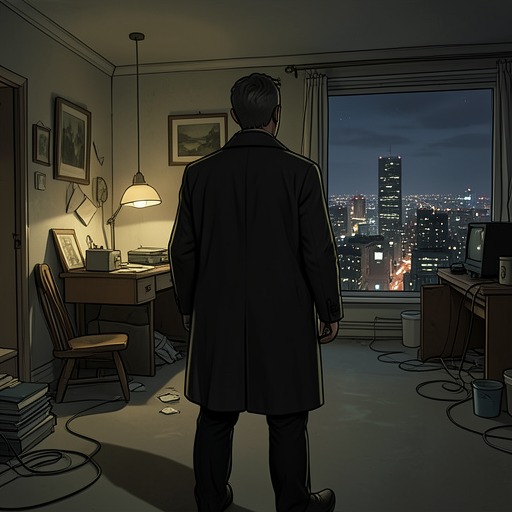
The opening establishes this double position physically. Tom enters dressed as a merchant sailor, crosses to the fire escape, stops to light a cigarette, and addresses the audience. From there he turns the clock back to the thirties and describes a society struggling with a dissolving economy, labor disturbances, and confusion. He places the family’s story within this wider setting, then identifies the work as a memory play: dimly lit, sentimental, nonrealistic, and accompanied by music because, in memory, events seem to happen to music. The frame therefore makes his escape both an event in the family’s past and an act of narration in the present.
Work, Family, and the Pressure to Leave
Tom’s warehouse job is the material center of his conflict. During an argument with Amanda, he insists that he does not love the work or the Continental Shoemakers, and describes the prospect of returning each morning as intolerable. For sixty-five dollars a month, he says, he gives up what he dreams of doing and being. His outburst answers Amanda’s fear that his conduct could jeopardize his job and the family’s security: Tom understands the household’s dependence on his wages, but experiences that dependence as a trap.
The conflict also has a personal history. Tom points to his father’s photograph and contrasts himself with the man who is gone, insisting that if he thought only of himself he would already have left as his father did. Amanda grabs his arm as he starts past her; he tells her not to hold him, and, when asked where he is going, says he is going to the movies. The scene makes his departure impulse concrete while showing that, for the moment, it remains entangled with the routines and confrontations of home.
Money and abandoned plans sharpen the family’s anxiety. Amanda recalls that Laura’s business-college tuition cost fifty dollars and laments that the family’s hopes and ambitions for her have come to nothing. Laura explains that she could not face the course; Amanda then imagines a future of lifelong dependency, with unmarried women living on relatives’ grudging support. Tom’s wage is not merely a personal frustration in this setting: it is part of the fragile security on which Amanda fears the household depends. When Amanda later reminds him of an overdue light bill for which notices have arrived, his brief acknowledgment brings that continuing financial pressure back into the domestic scene.
The Decision to Change
Tom’s plans become more definite in a conversation with Jim O’Connor. Leaning over the fire-escape rail, with movie-house marquees lighting his face, he says he is about to commit himself to a future without the warehouse, Mr. Mendoza, or even night school in public speaking. The sailor’s image from the opening now acquires a plot significance: Tom is not simply imagining another life but approaching a break with his established employment and routine. When Jim asks what he is talking about, Tom replies that he is tired of the movies, distinguishing the fantasy of escape from the change he is preparing to make.
That change carries a cost. Tom’s later account says that he was fired after writing a poem on a shoebox lid. He then left St. Louis, descended the fire-escape steps for the last time, and followed his father’s footsteps. The sequence links the poetic impulse already associated with his identity to the loss of his job and departure from the family home. The fire escape, first a place where he addresses the audience, becomes the threshold he crosses out of the household.
Departure and Its Aftermath
Tom describes extensive travel after leaving, comparing the cities that passed around him to brightly colored leaves torn from their branches. He says he would have stopped, but something pursued him and returned unexpectedly. The account does not present travel as a cure: motion changes his surroundings, yet the recurring pursuit turns distance into a route through which the past keeps returning.
The clearest form of that return is Laura. Tom imagines encountering a shop window filled with colored glass and delicate transparent bottles, and then feeling his sister touch his shoulder and meeting her eyes. He addresses Laura directly, acknowledging that he tried to leave her behind but proved more faithful than he intended. When memory overtakes him, he tries to escape it by reaching for a cigarette, crossing the street, going into a movie house or bar, buying a drink, or speaking to a stranger. These efforts do not undo the image of Laura; the speech ends with his desperate wish to blow out her candles.
Meaning of the Ending
Tom’s closing account revises the apparent meaning of his departure. He says he did not go to the moon but much farther, then describes time as the longest distance between two places. His travels have taken him away from St. Louis, yet memory keeps collapsing the distance between the traveling narrator and the sister left at home. The father’s example offers a path of movement, but not freedom from familial attachment: Tom follows in those footsteps and remains haunted by Laura.
The staging makes this divided ending visible. During Tom’s speech, Amanda appears behind the transparent barrier to comfort Laura, whose hair initially hides her face; Laura eventually lifts her head and smiles at her mother. Amanda’s gestures are slow and graceful, and she glances at the father’s photograph before withdrawing. When Tom finishes, Laura blows out the candles. His narration has carried the family into the past, but the final action belongs to Laura, while the brother’s last words disclose that departure has not silenced his attachment to her.